
How to Plan Wedding Transportation in New Jersey
Introduction: Why wedding transportation planning matters in New Jersey
Wedding transportation can seem straightforward until you put the full day on paper: people are getting ready in different places, guests may be staying at a hotel, the ceremony and reception may be at separate venues, and someone still needs a safe, clear ride home at the end of the night. In New Jersey, changing road conditions, venue access rules, and trips that cross into New York City can add more moving pieces.
Thoughtful wedding transportation in New Jersey is less about choosing a single vehicle and more about designing a dependable sequence of pickups, arrivals, and departures. As a wedding limousine service provider, J&C Limousine publishes this guidance to help couples turn that sequence into a plan that is easier for the wedding party, guests, venues, and transportation provider to follow. The goal is not to schedule every minute rigidly; it is to remove avoidable uncertainty before the day begins.
Start early enough to confirm who needs transportation, where each trip starts and ends, and which moments cannot run late. Once those basics are clear, vehicle selection and timing become much easier decisions.
Start with the people, locations, and transportation needs
Before comparing a limousine, party bus, or shuttle, identify the actual transportation obligations. A vehicle is only useful when it supports a specific passenger group and a specific trip. This first step prevents a common problem: booking for the bridal party but overlooking a hotel shuttle, parent transportation, or the couple’s late-night departure.
List every passenger group and trip
Create a wedding transportation checklist that lists each group separately. Do not assume that everyone travels together simply because they are attending the same event. Different readiness times, locations, mobility needs, and departure plans may call for separate arrangements.
- Couple: travel to the ceremony, photographs, reception, and any planned end-of-night destination.
- Wedding party: transportation from getting-ready locations to the ceremony, photos, and reception when needed.
- Parents and immediate family: transportation that helps them arrive comfortably and on time, particularly if parking or walking is difficult.
- Wedding guests: a guest shuttle or hotel pickup when many attendees are staying in one place or when venue parking is limited.
- Guests with individual needs: consider accessibility, young children, older relatives, or anyone who should not need to navigate an unfamiliar route.
- End-of-night riders: the couple, wedding party, or guests who need a scheduled trip after the reception.
For each trip, record the approximate rider count, pickup address, required arrival time, and whether luggage, formalwear, or personal items affect the space needed. This is the practical answer behind the question of how many limousines your New Jersey wedding may need: count trips and passenger groups, not merely the total guest list.
Map hotels, ceremony venues, reception venues, and other stops
Next, place every location in the order it will be used. Include getting-ready suites, hotels, the wedding ceremony, photo locations, the wedding reception, after-party plans, and end-of-night drop-offs. A transportation plan is often more complex when a trip has several stops, so distinguish between a direct ride and a route with pickups or staging time.
Ask each venue and hotel about its designated loading area, vehicle entrance, parking restrictions, and preferred arrival process. A venue may have a separate entrance for larger vehicles, while a hotel may need advance notice for a group pickup. If a hotel, ceremony, or reception route includes Hackensack, include the complete address and any site-specific instructions rather than relying on a neighborhood name alone.
For events with a New York City pickup or drop-off, build in additional route coordination and confirm the exact location, not just “the city.” The appropriate plan can differ substantially based on the street, pickup window, and surrounding event activity. If that is part of the itinerary, identify NYC clearly in the route notes for your transportation provider.
A simple planning grid can reveal gaps before they become day-of problems:
| Trip | Who rides | From and to | Arrival goal | Details to confirm |
|---|---|---|---|---|
| Getting ready to ceremony | Couple or wedding party | Suite or hotel to ceremony venue | Before pre-ceremony photos | Loading area, garment space, contact person |
| Hotel guest shuttle | Wedding guests | Hotel to ceremony or reception | Before the stated start time | Pickup window, return schedule, rider count |
| Ceremony to reception | Couple, party, or guests | Ceremony venue to reception venue | For introductions, cocktails, or photos | Photo stop, parking, venue entrance |
| End of evening | Couple or designated guests | Reception to hotel or home | After the planned send-off | Final pickup point and departure contact |

J&C LIMOUSINE SERVICE NYC | NJ
Luxury transportation for every occasion.
- Professional Chauffeur Service
- Luxury Fleet
- Airport, Corporate & Special Events
- Reliable & On-Time Service
- Serving NYC & North Jersey
Choose vehicles based on the actual wedding-day plan
The right vehicle choice follows the itinerary, passenger count, and experience you want to create. It should also account for whether riders must travel together, whether they have formalwear or personal items, and whether the group is moving once or several times. Booking a larger vehicle does not automatically solve logistics if the pickup sequence and capacity assumptions are unclear.
Decide whether one vehicle or multiple vehicles make sense
One vehicle can be practical when the couple and wedding party begin in the same area, travel together, and have compatible timelines. Multiple vehicles are often easier when the couple is getting ready separately, the wedding party is split between locations, parents need a quieter direct route, or guests require a hotel shuttle on a different schedule.
Consider multiple vehicles when one group would otherwise wait a long time for another group, when a single route would require backtracking, or when a large group cannot comfortably travel within the needed time window. Separate transportation can also protect the ceremony timeline: a guest shuttle should not depend on the bridal party finishing hair and makeup, and the couple’s photo schedule should not rely on a guest pickup.
Vehicle capacity should be confirmed for actual passengers, not a hopeful estimate. Leave reasonable room for dresses, suits, bags, and comfortable entry and exit. Before finalizing, verify whether everyone is expected to ride on every leg or whether some guests will use their own cars. A clear headcount for each trip is more useful than one broad guest total.
Compare limousine and party bus considerations
A limousine may suit a couple, a smaller wedding party, or family members who need a more direct, intimate trip. A party bus can be useful for a larger wedding party or a group that needs to remain together between locations. Neither is universally better; the decision should support your passenger count, route, timing, and desired separation between groups.
When weighing a wedding limo versus a party bus, focus on practical questions:
- How many people will ride on each leg of the transportation timeline?
- Will the group need space for formal attire, bags, flowers, or other items?
- Does the venue have appropriate access and loading space for the planned vehicle?
- Will the vehicle make several stops, and can those stops fit the available window?
- Would separate vehicles reduce waiting for the couple, family, or guests?
Keep the decision tied to the wedding day rather than to labels alone. The best plan is the one that gets the right people to the right place with enough time to arrive calmly.
Build a realistic New Jersey wedding transportation timeline
A wedding day transportation timeline turns your list of trips into a usable operating plan. It should show arrival goals, pickup windows, travel allowances, and the time required to load, unload, gather people, and enter each venue. The key distinction is between a scheduled pickup time and the time people actually need to be ready at the curb or designated loading area.
Work backward from ceremony and reception arrival times
Start with the times that cannot move easily. The ceremony may require the couple and wedding party to arrive before guests; the reception may require the couple to be ready for introductions or photos. From each required arrival time, work backward by accounting for travel, pickup, loading, and a realistic readiness window.
For example, do not set a wedding party pickup at the exact time the group should leave the hotel. Set a pickup window that allows people to gather, check that no one is missing, load belongings, and depart with enough time remaining. If photographs are planned between the ceremony and reception, treat that as its own timed stop rather than assuming it will happen automatically along the route.
Couples who want a more detailed sequence can use this guidance on how to build a New Jersey wedding transportation timeline. The important outcome is a schedule that distinguishes “be ready,” “vehicle arrives,” “vehicle departs,” and “group arrives.”
Add buffers for traffic, loading, photos, and venue access
Buffer time is not wasted time; it is the space that keeps one small delay from affecting the ceremony or reception. New Jersey travel can be affected by congestion, roadwork, weather, special events, and incidents. Build extra time around routes with more uncertainty, routes crossing busy corridors, and travel during peak activity periods. Your provider can use the final itinerary to plan appropriately, but venue and couple coordination still matter.
Shortly before departure, check NJDOT’s 511NJ travel information for active incidents, congestion, construction, weather, or special events affecting the route. It is a helpful supplemental tool for monitoring conditions on major New Jersey roads; it does not replace confirming the venue entrance, pickup point, and day-of schedule with the people involved.
Also allow time for tasks that are easy to overlook:
- Gathering a wedding party from several hotel rooms or getting-ready spaces.
- Loading dresses, personal items, flowers, or overnight bags.
- Walking from the drop-off point to the ceremony or reception entrance.
- Completing photographs before the next scheduled movement.
- Waiting for guests to board a shuttle at the end of the reception.
Plan the end of the evening
End-of-night transportation deserves the same attention as the ride to the ceremony. Decide whether the couple has a planned departure, whether the wedding party has a separate ride, and whether guests need a return shuttle to the hotel. If transportation runs in rounds, communicate the final departure time and whether there is a last-call procedure.
For guest shuttles, a short return window after the reception may work better than asking the vehicle to wait until every guest is ready. For the couple, confirm the final pickup location, who gives the departure signal, and where overnight items will be placed. A clear plan lets the celebration end without a scramble over keys, parking, or who is responsible for getting home.
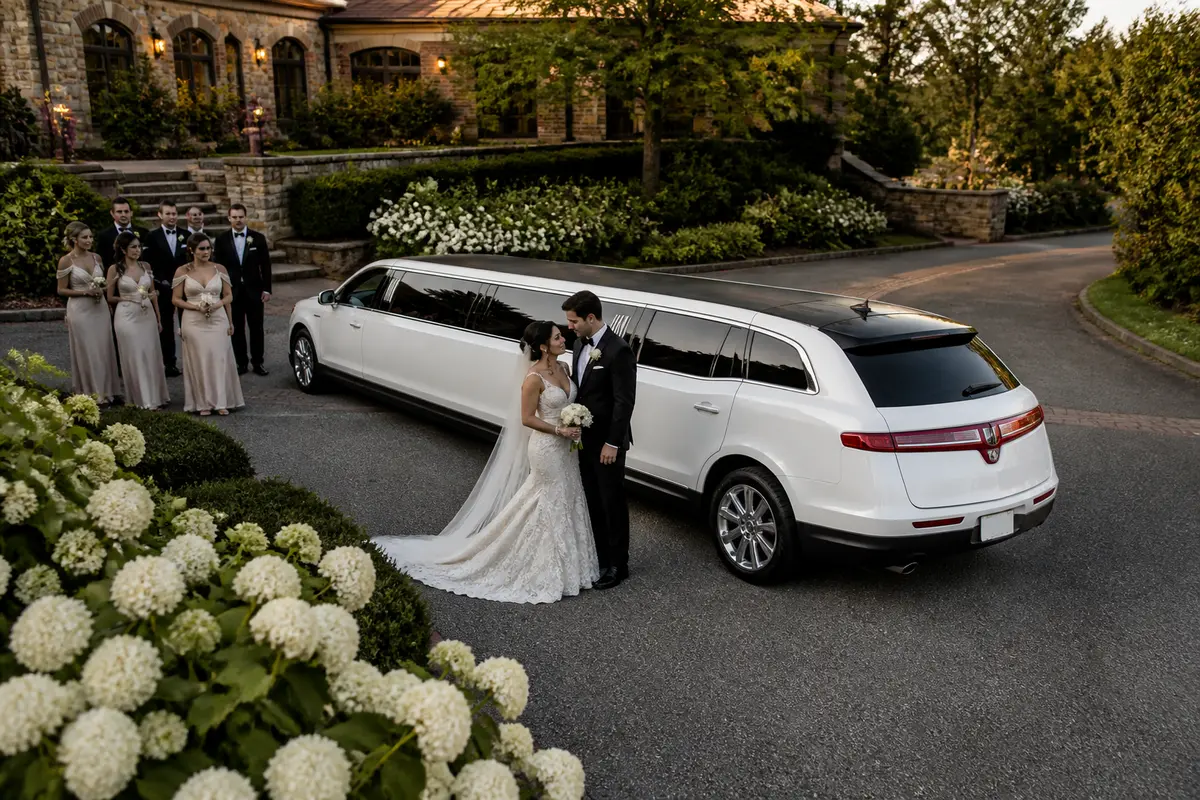
Coordinate hotels, venues, guests, and transportation providers
Even a well-designed route can falter when key details are held by different people. Hotels know their loading procedures, venues know their entrances and event schedule, and a transportation provider needs the final addresses, passenger counts, and timing. Bring those details together in one current document and share the portions each person needs.
Confirm venue and hotel access details
Ask each location for practical instructions well before the wedding day. Confirm the preferred vehicle entrance, loading and unloading area, parking rules, contact person, and any timing restrictions. If the ceremony and reception are at the same property, clarify whether the vehicle should remain on site, return later, or move to another staging area.
Hotels need similar attention. Verify where guests should wait, whether a group pickup requires advance notice, and whether the front entrance can accommodate the planned vehicle. If you are working through multiple locations, keep a single version of the route plan so an address change or revised photo stop is not communicated inconsistently.
For a structured approach, review how to coordinate hotel, ceremony, and reception transportation and adapt the sequence to your own venues. The details may seem small, but they determine whether passengers know where to be and whether the vehicle can load efficiently.
Give guests clear pickup and drop-off information
Guest communication should be simple enough to understand at a glance. Put transportation details on the wedding website, in a welcome note, or in a message sent shortly before the event. State the hotel pickup location, the first departure time, whether there are return trips, and the final shuttle departure. Explain that the schedule is designed to help everyone arrive before important moments rather than treating it as a casual suggestion.
Useful guest-facing information includes:
- The exact pickup point, such as the hotel lobby entrance or a named loading area.
- The pickup window and the departure time.
- The destination and whether the shuttle returns to the hotel.
- The final return trip time and what guests should do if they miss it.
- A day-of contact for urgent schedule questions.
Do not overload guests with the complete bridal party itinerary. Give them only the details that affect their trip, and keep the information consistent across invitations, the wedding website, and reminder messages.
Assign one person to manage transportation on the wedding day
The couple should not be responsible for answering transportation questions while getting ready, taking photos, or greeting guests. Assign one transportation coordinator: this could be a planner, trusted family member, or wedding party member who understands the schedule and has authority to communicate changes. That person should have the transportation provider’s contact information, the venue and hotel contacts, the final route plan, and a list of groups riding on each trip.
The coordinator’s role is not to manage every passenger personally. It is to confirm that the plan is moving as intended, relay a significant update if needed, and keep the couple from being pulled into avoidable logistics. Make sure this person knows who can approve a change if a pickup point, photo stop, or timing issue arises.
When professional wedding transportation in New Jersey can help
Professional transportation can be especially useful when the wedding involves several passenger groups, separate venues, hotel shuttles, an unfamiliar area, or a schedule where late arrivals would affect the ceremony or reception. Rather than asking friends or family to drive, park, track directions, and remain available throughout the day, couples can centralize the transportation portion of the plan with a provider.
For couples evaluating New Jersey wedding limo services, the most productive conversation begins with the itinerary. Share the real complexity of the day rather than requesting a vehicle before the schedule is complete. This helps clarify whether one vehicle, multiple vehicles, or guest transportation is appropriate for the plan.
Information to prepare before requesting service
Prepare a concise transportation brief before contacting a provider. It does not need to be final, but it should give enough detail to discuss options accurately.
- Wedding date and estimated service windows.
- All pickup, ceremony, reception, hotel, and final drop-off addresses.
- Passenger counts for each distinct trip.
- The proposed order of stops and target arrival times.
- Whether the couple, wedding party, family, or guests travel separately.
- Venue access, loading, or parking information already provided.
- A primary planner or transportation coordinator contact.
- Known needs involving formalwear, luggage, mobility, or end-of-night transportation.
It is normal for a few details to change during planning. What matters is having a reliable process for sharing updates so the final pickup and drop-off schedule reflects the actual wedding day.
Questions to clarify before finalizing the plan
Before confirming service, make sure both sides understand the same itinerary. Ask how the provider wants timing changes communicated, what information drivers need for venue access, and how day-of contacts will be handled. Confirm the service window, the number of planned trips, passenger capacity assumptions, and whether your schedule includes sufficient time for loading, photos, and venue transitions.
You should also clarify which person is responsible for telling guests about shuttle times, who confirms the final itinerary, and what to do if a venue changes its loading instructions. These questions are not about expecting problems; they are about ensuring that no one has to solve basic coordination issues during the celebration.
Final checklist for a dependable New Jersey wedding transportation plan
A dependable plan for wedding transportation in New Jersey connects the people, places, vehicles, and timeline into one clear sequence. Finalize the essentials early, then review them again as the wedding approaches:
- Every passenger group and trip has been identified.
- All hotel, ceremony, reception, photo, and final drop-off addresses are confirmed.
- Vehicle capacity matches the actual riders and their needs for each trip.
- Pickup windows include time to gather, load, and depart.
- Arrival goals include reasonable buffers for travel conditions and venue access.
- Hotels and venues have confirmed loading, parking, and contact details.
- Guests have simple, accurate shuttle instructions.
- One day-of transportation coordinator has the final itinerary and contacts.
- The end-of-night plan is clear for the couple, wedding party, and any shuttle riders.
The strongest plan is not necessarily the most elaborate one. It is the one that gives each group a clear ride, gives the schedule enough breathing room, and gives the couple confidence that transportation will support the celebration rather than distract from it. If you are ready to discuss the vehicle and itinerary side of your day, J&C Limousine can help you explore wedding limousine transportation in New Jersey around your planned stops, passenger groups, and timeline.
Ready To Book Your Next Luxury Limousine Ride?
Airport Transfers – Corporate Travel – Special Events
Travel in comfort and style with J&C Limousine. From airport transfers to special events, we provide reliable, professional transportation for a smooth and comfortable journey.